Showing posts with label travel. Show all posts

Wednesday, March 2, 2011

New Additions to my Pedigree

For a frame of reference, this was my pedigree BEFORE I spent a week collecting data at the Family History Library in Salt Lake City, Utah.


Well, my time is up in Salt Lake City. Time to pack my computer, my notes, and my clothes into a suitcase and fly back to Charlotte, NC.

Before I left for SLC a week ago, I told my family and friends that if could not find even one more person to add to my pedigree, it would be OK- the trip would still be worth it. I just wanted to see this world famous collection of genealogical data at the Mormon's Family History Library; to see what the Library had to offer. I was very impressed and pleased, and moreover, I did climb up a few more branches on my family tree.

Also, I had the opportunity to see changes that are happening at the Library. For example, the Library catalogue is searched by going to FamilySearch(dot)org on the Internet. The "face" of that website is being changed, though I confess I still go back to the old face to perform my searches.

So, I found a lot of new information and pushed back one of my maternal ancestral lines about three generations. I say "about" because I have not had a chance to analyze the new data. I have been sitting in front of the microfilm readers from dawn until way past dusk and feeding nickles into the photocopy machine.

But briefly, follow the bottom line of my mother's branch in the pedigree above. Note that my great, great grandparents were Ludwig Gutgsell and Margarethe Kessler. I obtained their birth dates and places from the death entry of their daughter, Marie, nee. Gutgsell. Her death entry was recorded in the parish record of a catholic church in Burglen, Canton Thurgau, Switzerland, but that's another story. This week, I found the marriage entry (performed on 17 Nov 1847) of Marie's parents on a microfilm of the civil marriage registrations for the commune (village) of Kaysersburg, arrondisement (county) of Colmar, Department of Haut Rhin, in Alsace, which was in French territory at the time. The Germans occupied Alsace from about 1871, until the end of WW I, and then it was returned to France. So, Marie's parents were married by their French names: Louis and Marguerite. I just love the details of genealogical research.

The information didn't stop there, there were many genealogical details in the full-page, marriage entry in this civil record. More research in the microfilm section revealed the marriage entry for the parents of Louis Gutgsell. Louis' father, Andre Gutgsell married Madelaine Scherrer on 28 Jan 1824, in Kaysersburg. I also found some of Andre's siblings. THEN, I discovered that Andre's parents, Leo Gutgsell and Marie Ann Madar, were married in Kayserberg. Finally, the parents of Leo were Joseph Gutgsell and Elizabeth Wachen. If I recall correctly, Andre Gutgsell's marriage entry included the names of his parents and grandparents.

Incidentally, while perusing the microfilms of data from this region of Alsace, I noted another prominent surname, "G'sell". At first I thought it was an abbreviation for my ancestral surname, Gutgsell, but after looking at several family relationships in the records, I do not believe G'sell is equivalent to Gutgsell. Furthermore, Gutgsell seemed to be spelled variously as Guthgsell, Guttgsell, and GutheGsell. To further confound the issue, many times the names of individuals were not captalized.

So, how many generations did I uncover? I believe I am back to my 5X great grandparents on the Gutgsell line. Not a bad effort for a week's research at the largest depository of genealogical data in the world.

Tuesday, March 1, 2011

Miracle of the Sea Gulls, Salt Lake City

From Life's Journey II

Image: Click to enlarge. Note the sculptures of Sea Gulls on the roof of this trolley station in down town Salt Lake City, Utah, near Temple Square. One of the birds is silhouetted against the snow-capped mountain in the distance.

For those of you who are old enough, do you remember the TV series, "Death Valley Days" which appeared in the 1960s. The episode opened with a man standing up behind a desk and announcing, "Hello folks, this is the old Ranger". Then he proceeded to introduce the audience to a true tale of the old West. The setting of each story was somewhere near Death Valley on the border between California and Nevada. The show was sponsored by "Twenty- Mule Team Borax." a laundry detergent which was made from a mineral mined near Death Valley. The musical theme was the sound of bugles playing like they do when the cavalry is coming.

One episode really stuck in my mind and still does. It was the true story about an event that occurred during the first year that the Mormon pioneers settled in an area that would eventually become Salt Lake City. As it goes, the Mormons were getting ready to make their first crop harvest. Suddenly, thousands of crickets descended on the fields of ripened grain and proceeded to devour the only food that would be available to the pioneers. Certainly they would starve over the Winter. Then just as suddenly as the crickets appeared, thousands of Sea Gulls flew in and devoured the crickets, thus saving the harvest and the Mormon families.

In honor of the Sea Gulls and their miraculous appearance in the desert, these sculptures of the bird are attached to the roof of the tram station near Temple Square. A little more research about the story revealed the location of perhaps the first and maybe only monument dedicated to Birds in America. Come to think of it, I know of no such other. Incidentally, the California Gull is the State Bird of Utah.

The image below presents the Gull monument which has been placed in front of the Assembly Hall on the grounds of Temple Square. By the way, the Assembly Hall is a meeting place for community events. It was constructed from granite blocks left over after the building of the Mormon Temple.

From Life's Journey II

Wednesday, April 21, 2010

Festival of Postcards-8th Ed: Geography

The 8th edition of "Festival of Postcards" is calling for vintage postcards that depict some aspect of geography- maps, landmarks, and so forth. I immediately thought of where I would go for this one.

(click image to enlarge)

As shown above, I put together some of my STATE postcards and mounted them in a 24 x 36 inch poster frame. I tacked the project to the breezeway of my home so I could look at it every time I go out or enter the house. I tried to put the states into their relative position or locations in the United States: East, Middle, West. I will probably re-do the project some day because I have a few more states to add. You can see "California" was stuck under the edge of the frame in lower right-hand corner. I will have to open the frame and put the state in its relative position. Right below "Montana" (left side), you may be able to see the reverse of a card (stamped and sent from Nebraska, Spring 2005) to my friend telling her of my postcards idea:

"Dear Annie, One of the few things I dream about when I get back to my homey little nest is making a poster of all my state postcards. I believe most of my travels and adventures will now be limited to looking at the cards from my big green arm chair"

At the time, I was working a month-long contract as an instructor in radiation safety at the Fort Collins Nuclear Plant located on the Missouri River, near Blair, Nebraska. Actually, I have collected most of these cards while working at, or enroute to, jobs at nuclear power plants all over the States. Sometimes on my day off, I would browse antique stores and flea markets for vintage cards of the states, such as those shown in the close-up below. I believe the cards of Mississippi, Texas, and Tennessee (with scalloped edges) and a few others out of view could be considered vintage.

Some of the cards (in first image) like the one of the Great Smokey Mountains and one of the New River (in NC and VA) are close-ups of those particular areas. Many of the cards have pictures of landmarks or activities that are unique to that state which bring back memories to me of when I was there.

Incidentally, I am missing the states of Wyoming, Kentucky, Missouri, and Maine. So, if you have an inkling, please mail* me a card from these states and I will send you a "thank you" postcard from North Carolina (modern). Oh yes, I have been through these states. I even worked a contract at the former Maine Yankee Nuclear Plant- in January!

*Bob Kramp at 105 N. Westover Dr, Monroe, NC 28112

REFERENCES AND LINKS:

Postcard collectors and genealogists: Learn about the Festival of Postcards at the web site of our host, Evelyn Yvonne Theriault.

Often when I comtemplate extensive travels, I recall a song made popular by the country singer, Hank Snow, called "I've Been Everywhere". It was the genre's top single in 1962. Johnny Cash also recorded it. I discovered today that the song was originally written about Australian locations according to Wikipedia. By the way, never freely give out your mobile phone number or email with out thinking about it. Now, go to the American version of ... Everywhere and its impossible-to-remember verse lyrics.

Thursday, April 15, 2010

Faith of Our Fathers

As I become older (and supposedly wiser), I enjoy looking back into our history and re-discovering some of the values that were held by our earlier generations. Indeed, I am becoming a member of one of those earlier generations myself. And what do I mean by values? I believe I am thinking about the good things in Life's Journey that mean something significant- those things that stick with you and those things that can get you through some tough times.

And so it happened on a recent trip that I noticed an historical marker on my way out of an overnight camp at Kerr Reservoir on the border of North Carolina and Virginia. On State Hwy 39 at Townsville, the marker stated:

"St. John's Episcopal Church. Parish established 1746. Present Building completed 1773 stands 200 yards West".

It was a beautiful, sunny, early Spring morning, and I could make the time. So, I drove over to the church. There, on this country road on the Piedmont of North Carolina, I stopped to walk around the outside of the church and take some pictures. I wondered what it would have looked like on a similar Sunday in Spring over 200 years ago.

Above image: Saint John's Episcopal Church, rear view; note the large shuttered windows. Click on image for larger view.

Above: The front of the church was quite unique- large windows, curved steps, giant cedar trees, and a bronze tablet on the right side of the church, above the boxwood bush, that read:

Saint John's Parish Church founded 1746, Williamsborough, North Carolina
This Tablet is erected by the North Carolina Society of the Colonial Dames of America under the auspices of the Vance County Committee, Henderson, NC, Friday, October 25, 1935, in honor of the reverend memory of those who in building the State founded it upon their faith in God,
"Faith of our Fathers, Holy Faith, we will be true to thee till death".
Saint John's Parish was visited in 1749 by Reverend Clement Hall who baptized 184 children.
First Rector, 1766
The Reverend Charles Cupples
Sent out by the Society for the Propagation of the Gospel, London.
First Vestry
(followed by a list of persons)

Can you imagine, my friends, 184 children being baptized on one Sunday. Now, that's a lot of Faith. I looked around the area from my stance in front of the church. Not much else was happening on this Thursday morning on the second day of April.

Post Note: Henderson is the county seat of Vance County, NC. I heard on cable TV, Solid Gold Oldies, that one of The Drifters (recall the tunes, "Under the Boardwalk" and "Up on the Roof") was born in Henderson, NC. They played such great music BACK then.

Wednesday, March 31, 2010

Got a light?

Pioneer and farmer, Washington Duke of NC, was drafted into Confederate Navy. He was captured and became Prisoner of War. After war ended, he walked from New Bern, NC, to this homestead near Durham with 50 cents in his pocket. Here, he and his sons grew Gold Leaf tobacco and founded The American Tobacco Company. Washington's grandson, James Duke, endowed 30 M to Holy Trinity College in 1930 which changed its name to Duke Univ. And now WD's namesake is in the Final Four in NCAA Basketball. The guy can't lose.

Sunday, January 10, 2010

Sentimental Sunday- Hiking no more?

OK, I bought into the Sentimental Sunday posts by the Geneabloggers group. I don't know how I am going to transfer this post to the list of entries by other bloggers, but I will eventually find out- one of these Sundays.

I spent a couple of hours this morning reading the Sentimental entries by other geneabloggers and they were great reads- a little bit different from some of the drier entries about genealogy and family history. They seem to focus more on intimate memories of persons and events. As I read, I kept looking in the back of my mind for some of the events in my life which are sentimental to me. The thought of hiking came to mind- actually of the time when I might have first fallen in love with hiking. I had to dig way back into both my memory and my photo albums. And I came up with the following image of some of the neighborhood kids and I hiking in the big woods near our homes in suburban Maryland. It was 1954, over fifty years ago. In the picture, we are hiking along a nearly dry creek bed. It was in the scattered puddles, that we crept up on frogs, salamanders, box turtles, and captured them for a closer look. I remember one time collecting at least 20 turtles which we took home and started a little zoo- until our parents made us release the reptiles back into the woods. That was when I first fell in love with the natural out-of-doors. However, I get sort or sad when I look at this photo, because the opportunity for this particular hike is no longer possible. A wide swath of the woods was paved over for the Beltway (I-495) of Metropolitan Washington, DC. More land was taken over for apartments and condominiums.

Hiking! I love it. I was born to hike. But the overall sentiment about this life-long love, is that it may be a thing of the past- no longer possible for me. For y'see, I have to walk with a cane now. My hiking legs have become so weak. And this is difficult to write about. I have been taking anti-androgen hormones for about 5 years now to suppress the proliferation of prostate cancer cells. Testosterone is a great hormone, but the lack of it means wasted muscle tissue and its replacement by fat cells. I sometimes wonder when the time will come when I advance from hobbling on a cane to a wheel chair. But even then I believe that some adjustments can be made so that I can still "go hiking" in my beloved woods.

This summer, I was camping in the Jefferson National Forest in Virginia at a place called White Rocks primitive campground. On the way to the campsites, I passed a short trail named Cherokee Flats. I pulled into the parking area and took a short walk- with my cane. The trail was quite flat and paved for most of its distance. The trail passed through a pristine forest among Rhododendrons, still showing the last blooms of late summer. The trail ended too quickly at Stony Brook creek, but long enough to experience THE HIKE.

Image: Walking slowly through the Cherokee Flats trail in Jefferson National Forest, VA

Friday, November 14, 2008

Small World Department- Delfosse Descendant

I think it is because I do genealogy that I am so aware of people and events around me. Take a few days ago for example when a house guest and I were touring Old Salem in Winston Salem, North Carolina. Old Salem is a “living museum” created within the limits of the city. It was founded about 1753, as a settlement for a religious sect known as the Moravians from former Moravia in Bohemia, Germany. Today, Moravia is in western portion of the Republic of Czech. The descendants of the Moravians, with the help of others, preserved many of the homes of the original settlement and have recreated many of the shops and activities of the original settlers such as gardening and baking and gunsmiths.

My guest and I prepared to take a break on this warm, sunny Fall day and eat our fresh raisin and oatmeal cookies we had just purchased from the Moravian Bakery. I noticed the lady sitting across from me wore a name tag identifying her as Darlene Delfosse. I told her I was interested in her unique surname because one of my ancestors married a Delfosse.

“Oh, my husband was a Delfosse from Smoke Run, Clearfield County, Pennsylvania”, she informed me.

“And it’s nice that you pronounced the name correctly” she added. (I pronounced the ending like “boss” with a silent “e”).

Well that clinched it. Her late husband was undoubtedly related to the former Mae Louise Delfoss, who was the wife of my father’s step brother, Richard M. Kramp. Mrs. Mae Kramp, nee. Delfoss, or Mary as we called her, was a daughter of John B. “Jack” Delfosse and the granddaughter of Desire Delfosse and his wife, Marie. The progenitors had immigrated from Lievin, in northern France, in the 1880’s and settled in Pennsylvania. They had nine other children besides Jack Delfosse.


Image: Mrs. Darlene Delfosse, of Bern, North Carolina, whose husband's family line is related through marriage to our Kramp Family Line from Pennsylvania.

Of course, I did not have my computer with me; nor did I have my genealogy books and printouts nearby. And I didn’t even think of giving her one of my personal cards- which I had left at home anyway. From now on, I will carry several cards with me- at least giving information on how to access this blog. I wish I could have shown Darlene the following photograph taken at IOOF Cemetery, Brisbin, PA, which shows the tombstones of her husband’s ancestors.

Image (above): The Delfosse Plot at IOOF Cemetery, Brisbin, in southeastern Clearfield County, PA. Desire and Marie Delfosse were the grandparents of Mae Louise “Mary” Delfosse, who married Richard Melvin Kramp, son of Richard Otto Kramp and Bertha, nee. Fox. Louise M. Delfosse was the first of ten children born to Desire and Marie.

Incidentally, Mrs. Mary (Delfosse) Kramp was the last and only KRAMP listed in the Clearfield County (PA) telephone book before she died in August 2005.

One more note on the Delfosse name: On a recent car ride in Virginia, on state route 29, about halfway between Charlottsville and Danville, I noticed a road sign announcing the location of "Delfosse Winery". I better get up there again soon, as I may have a family discount waiting for me on a case of my favorite libation.

References and Links:
The Defosse Winery in the Blue Ridge Mountains of Virginia. I would have never seen the details if I had not blogged this entry. It was there in Google all this time waiting for me to search and find it.

Tuesday, October 14, 2008

Statuary (Einstein & Jefferson) of Washington, DC

One thing about coming back home for a visit: this time one comes back as a curious tourist. I was born in Alexandria, VA, and when I was about six years old, my family moved to Bethesda, MD, just about 4 miles north of the District of Columbia city boundary. After I graduated from High School and the University of Maryland around 1964, I left the Metropolitan area, never to return again as a resident. Well, I did return to live for about a year in 1967, after serving my military obligation, but I don't count that.

But now, I come back to visit my family and relatives, with a new passion for gathering family history and learning more about the events of our country's heritage which has influenced us. You see, now I have the time to read and reflect on our national heritage and how it has become entwined with my own, personal "Life's Journey". So, during the last week, I visited several memorials and monuments in the Washington, DC, read the guidebook descriptions, and took pictures. There is not a better place to learn about our national heritage than Washington, DC.

Image above: Do you believe in osmosis? I am laying my head on the lap of the famous Albert Einstein in hopes that some of his intellect might seep into my own brain. Good Luck. This statue is on the grounds of the National Academy of Sciences. I noticed that many of the statues and memorials depict their subject in quite formal poses. However, more recent statuary shows the subject in a more relaxed, informal pose such as this one. The statue was sculpted by Robert Berks, and is 21 feet high from head to toe. It was dedicated in June 1979, the centennial of Einstein's birth on 11 Mar 1879. He died 18 Apr 1955, at age 76 years.

The papers in Einstein's left hand shows three equations of his most important scientific discoveries:

  • The Theory of General Relativity
  • The Photoelectric Effect. (Some of my former Health Physics students might be familiar with this equation- unless they weren't paying attention.
  • The equivalency of Energy and Matter. So simple and so elegant- why didn't I think of it first?

Incidentally, Einstein once said, "Politics is for the present, but an equation ... is for an eternity".

Einstein sits on a 3 step bench of white granite quarried from Mt. Airy, NC. On the back of the bench is inscribed a quote attributed to Einstein. Other scientists and genealogists should take note:

"The right to search for truth implies also a duty; one must not conceal any part of what one has recognized to be true"

And how does one recognize the truth: sources, sources, sources, and if one is lucky, PRIMARY sources. Of course, sometimes family historians might have to be a little discreet- at least for awhile.

Image: Einstein's statue sets on a slap, 28 feet in diameter, of emerald pearl granite from Lavrick, Norway. Embedded in the granite are 2700 stainless steel studs of various diameters which represent the stars in the heavens as positioned at noon on 22 Apr 1979 (dedication day). I'm no Einstein but the architects of this monument most surely were.

In the present campaign for President, both parties have claimed that their group represents CHANGE- as nobody seems to want to be associated with same old, same old, of George W. Bush's administration. However, after I climbed the steps of the Jefferson Memorial and then gazed around the rotunda, I was struck by an inscribed statement attributed to our second President, Thomas Jefferson. See the image below Jefferson's statue and click to enlarge.

Image: Thomas Jefferson in the rotunda of the Jefferson Memorial

What? "Barbarous Ancestors"- Thomas, what are you trying to say? It seems that Jefferson realized that institutions (and laws) must change to reflect and "keep pace" with the progress of man. I guess the question remains whether or not man is progressing.

Friday, October 10, 2008

A Trip to Great Falls, Virginia: Then and Now

My maternal grandmother, Mrs. Margaret Gailliot, formerly Margaret Austel, of Burglen, Canton Thurgau, Switzerland. Hand-written caption indicates picture was taken at Great Falls on the Potomac River, on the Virginia shore. Picture taken circa Summer, 1917. Can you imagine crawling over those rocks and water rivulets in a long Victorian dress.


My maternal grandfather, Charles Antony Gailliot, of Braddock, Allegheny County, PA, sits on the rocks of Great Falls, Virginia, circa Summer of 1917 or 1918. Charles and Margaret were married at St. Joseph's Roman Catholic Church, in Braddock, PA, on 6 August 1917. Almost the day after they were married, Charles received his induction notice to report to the Army to serve in WW I. However, he also received at the same time an offer to work as a pattern maker for the Navy Yard in Washington, DC. Thus, Charles and Margaret moved to the District of Columbia. Since his job was a part of the war effort, Charles was not drafted and remained state side. Since Charles' wife, Margaret had their first baby, Helen, in May of 1918, I am certain that these pictures were taken in 1917. Note the trees were in summer foliage.


Image: Bob Kramp, that's me, looks over Great Falls from the Virginia shore, October, 2008, about 90 years after his grandparents visited the same site. The information sign at this overlook is titled, "River of Change", as the area has seen several floods and gone though the process of erosion. But for me, it was certainly a time change, a time warp as they say, since the times of my grandparents.

I grew up in Bethesda, on the Maryland side of the Potomac River. As young kids, the neighborhood boys and I would often come down to Great Falls and climb for hours over the rocks with fishing rods in hand- looking for that special pool where grandfather bass resided. When we got bored of fishing, we could easily switch to catching dozens of water snakes. That was a long time ago. Today, the National Park Service which administers park lands on both shores of the Potomac at Great Falls has posted signs to stay on the approved walk ways and avoid stomping over the sensitive environment off-trail. This is a good idea considering the number of people who visit the park each year and the number of drownings that occur among careless hikers. There are still areas which have been set aside for official rock climbing.

This image of the Great Falls from the Virginia shore was taken with the wide view setting of my digital camera (click to enlarge). I believe my grandparents were probably crawling over the upper rocks of the Falls back in 1917, because it is a long drop to the river where I'm standing to take this photo.


A few days later, I was bicycling the first 11 miles of the former Washington and Old Dominion Railroad which has been converted to the 45 mile-long rail-trail located within the W&OD Regional Park. I suspect my grandparents took the electric car ride out to Great Falls on a side track off the W&OD. Though I don't know for sure, the trip was probably a honeymoon for my grandparents for at the time they visited it was indeed a wonderful resort. The text of this historical marker along the rail trail gives a hint of what it must have been like in the "old days":

The Great Falls Line

The Bluemont Branch of the Washington and Old Dominion was not the railroad's only line. The Great Falls and Old Dominion Rail Road arose in 1906 from the vision of two prominent men. Senator Stephen B. Elkins of West Virginia had prospered through coal, lumber and railroads in his home state. John R. MacLean was involved in several businesses and owned the Washington Post newspaper. Elkins and MacLean bought land on the Virginia side of the Potomac River at Great Falls. They turned it into a resort, complete with a carousel, dance pavilion, and electrified Trolley line to bring the crowds from Washington. The largely undeveloped land along the line was ideal for residential communities including one named for MacLean. [One rides though MacLean and Fairfax City on the trail]

Images of Elkins, on top, and MacLean, are in the upper, right-hand corner of the historical marker.

This trip to Great Falls, Virginia, was made as part of my effort and enjoyment to re-visit sites which were also visited by my ancestors. Previously, I have posted blog entries on my ancestors' trips to the replica of the Lourdes (France) Grotto and the Bartholdi Fountain, both sites being in Washington City, District of Columbia.

Thursday, September 18, 2008

Bicycling Thru History on the W and OD Rail Trail

On Tuesday, I started out on the 400 mile trip from Monroe, NC, to Wheaton, MD, not on my bicycle, but in my car. I am on my way to visit Mom in Hanover and hopefully gather more family history. But first, I made a stop at Duke University Medical Clinics to see my prostate cancer specialist. Also, I wanted to take a few pictures of Duke University's grand architecture, but it was pouring rain- perhaps on the way home it will be better picture-taking weather.

In any case, I wanted to celebrate the good news that my hormonal therapy continues to hold my blood levels of Prostate Specific Antigen in check, from 3.7 two months ago to 3.4 today. The details are boring but very important to me of course. So, when I arrived in the Washington, DC, area, I hopped on my bicycle at the Washington and Old Dominion Rail Trail and rode about 18 miles total, to and fro. At my starting point in Vienna, Virginia, I took this picture of my bike leaning against a mural painted on a nearby building.


The rail trail runs from the Potomac river, crossing the I-495 beltway, fortunately on a pedestrian bridge, and then continues on through never ending suburbia to Purcellville, VA. However, today, I rode from Vienna to the renovated railroad station at Herndon, VA. The trail is a regional state park, 100 feet wide and 45 miles long. That's a skinny park. The trail touches several other regional parks on the way.


The trail has been paved and now follows the Virginia Power Company's right of way. Thus, any tall trees have been cleared leaving the trail open to constant sun. Thus, you can be exposed to electromagnetic radiation on a pretty wide spectrum- not that it makes much difference heath wise- at least on today's knowledge. I guess the opportunity for good exercise overrides any negative impacts.


The trail follows the old railroad bed that was layed out about 1857. There is a quite a bit of Civil War history along the trail. During the War, the rails were removed by both Federal and Confederate troops to disrupt supply lines. Therefore, the Herndon Rail Station (image above) fell out of the railroad business for awhile. It was then used as a residence and store. After the War, the station was re-established and expanded. Rail transportation came to a dribble in the 1960s and eventually shut down all together. The Herndon Station was again threatened for demolition to be replaced by a parking lot. However, the townspeople came to the rescue and preserved the building making it into the Herndon Historical Society headquarters and store.

I sat on one of several benches in the restored town square; soaking in the sun, taking pictures and enjoying the final petunia blooms of Summer. Across the street, I noticed a new store, named "So Addictive Dessert and Internet Lounge". Just what could a store with a name like that offer a person like me? Only, HEAVEN.

Inside the station, one can find old records, pictures, and a collection of vintage items that continues to grow by donations. Each of the loose-leaf photograph albums layed open on a table inside the station contains numerous 8x10 inch reproductions of historical interest. A computer in the corner of the room will contain an index of surnames and a list of preserved items. The curator told me it was almost ready for use. So, if you have family that lived in Fairfax County, in particular, Herndon, VA, you have a treasure trove of historical information awaiting you.


And, now I can end this entry on a genealogical note. Along the trail, I took a break and sat on a bench which had a dedication plaque- a nice and practical way to memorialize the Razick Family- whoever they were. Makes me want to do an Ancestrydotcom investigation. Wonder what YEAR they came to America.


REFERENCES and LINKS:

Friends of the W&OD Trail: History, maps, and lots of trail pictures.

Washingtonpost dot com article by reporter, Francine Uenuma, appearing in Fairfax Extra section of newspaper on 19 June 2008. Interview and video about Paul McCray who managed the WOD Trail for 20 years and knows its history better than anybody. Permalink (I believe this is a never changing link to the Post article)

For visitors or residents, this site provides a great summary of all the trails in Washington, DC, area. Which ones are your favorites?

Tuesday, September 2, 2008

Kiepenkerl- Keepers of news and history

I went on a family history search to middle Europe in September, 2001. As I walked around Munster, Germany, I looked for sculptures and statues around city parks or squares that might depict the clothing styles and culture of the past. Three quarters of my ancestors on my pedigree were German-born before they immigrated to America in the 1880's.

I was sitting in an outdoor cafe having a Tass der Kaffee (sometimes I mix my weak French with my weak German). Across from my table was a statue or sculpture honoring the "Kiepenkerl". Asking around in my weak German, I learned that these men were traveling salesman of sorts who sold housewares. While traveling around the country, they also picked up local news and stories and passed them on to eager listeners in the next village. So, the Kiepenkerls were news reporters and story tellers as well as salesmen. I guess this was the old-fashioned equivalent of TV or the Internet.

I mused that genealogists and family historians are sort of like the Kiepenkerls. We collect family history and news and pass it on from one generation to the next. What an honor. What a privilege. What responsibility! And so, when I saw a representation of a Kiepenkerl painted on a small dish, I bought it as a souvenir for my genealogical curio cabinet.

As far as clothing styles go, the next image shows two views of an outdoor fountain in Lambert Square, Munster, Germany. The fountain was a sculpture depicting a family of Germans dressed in the styles of the 19th century, at least that's my presumption. First I noticed that they were carrying canes or walking sticks. The canes I surmise helped arthritic individuals to walk around. But, I am not sure of the purpose of the walking stick on a casual stroll to town. Perhaps it was used to keep stray dogs away. The women wore bonnets and bows and long dresses and aprons. The men had beards and smoked long-necked, curved pipes. They also wore three-quarter length coats which look like smocks. Their hats were what I would call captain hats with a brim. The shoes look like wooden clogs, like I imagine the Dutchman wore.


Later in the day in Munster, I found myself in the middle of a parade. I do not know what was the specific occasion for the parade. But in my experience, Germans don't need any particular reason for a celebration. They always seem to be celebrating and having a good time.

In any case, these "farmers" are wearing hats similar to that worn by the man at the fountain. Apparently bandannas and scarves were popularly worn around the neck. And if you look closely (click on image), the little slip-thingy on the twisted ends of the bandanna holding it in place is in the shape of little wooden clogs- which of course are like the ones worn on the feet, if you could see them.

Thus, you can see what your German ancestors might have worn in the 19th century if, on a trip to that country, you keep your eyes open and your camera ready.

REFERENCES and LINKS

My Pedigree presented in earlier blog entry.

My Family history trip to Gemany, Alsace, Switzerland, 2001

Two of the slides in this entry were created with Microsoft's Powerpoint application. I just came across a genealogy blogger who also uses the program for making genealogical slides and images and posts an instructional blog. Go to: http://professordru.blogspot.com/

A panoramic view of the park (square) and Kiepenkerl in Muenster, Germany. Scroll down on left margin to "Kiepenkerl".

Wednesday, August 20, 2008

Kramp Roads, PA Rest Stops and Kilt Towels

I believe there are many members of the Kramp tribe in Ontario, Canada. One of the visitors who I met at the Joseph Schneider Haus and Museum in Kitchener, Ontario, told me he had an uncle named Milton Kramp. I did not ask him if Milton lived at the end of Kramp Road, but my traveling companion did take a picture of the road. He was probably lost at the time, but the road lies somewhere between Kitchener and Guelph, Ontario (link to my Picasa Gallery and look at map).

The roads on our return home from Ontario eventually led us down Interstate 81 through New York to Pennsylvania. We stopped just inside the border near Summit, PA. The sign read, "Smile. You're in Pennsylvania, State of Independence". Well, OK, here goes. I believe "Independence" refers to the Liberty Bell which was located in Independence Hall, Philadephia. I should've asked, but actually, I thought all retirees were in the state of Independence.

I thought it was a neat idea to exhibit coal mining equipment at the Information Center and Rest Stop. Below is a picture of me standing next to a "Lokie". It is a battery-operated locomotive and car which once hauled anthracite coal through the mine tunnels toward the surface. It replaced the living, animal mule and increased coal production. This low-type Scout model locomotive was built by Greensburg Machine Company, near Pittsburgh, PA.


My late uncle Orville Shugar, husband of the former Bernice Kramp, was a former anthracite coal miner who lived in Wilkes-Barre, PA, just off I-81. Other Kramp relatives were also coal miners, but most of them mined soft coal (sulphur-rich) in western Pennsylvania, particularly along the Moshannon Vien in Clearfield County.

While we were in Ontario, a Scottish Highland Games was being held in Fergus, Ontario. My friend went to the Games while I finished up some last minute touring in Kitchener. I usually shun the wearing of heavy wool kilts during Scottish Games held in the heat of summer for obvious reason of discomfort. Hardly a breeze ever runs up me open legs, lad. However, my friend found a solution at one of the vendors at Fergus. It is a cotton towel designed like a kilt, complete with fancy sporron (the purse in front). Now, I can step out of a shower and right into a kilt. Would it be blasphemous to wear it at the next Scottish Games even in 92 degree temperatures?

Image: An answer to wearing hot wool kilts in the middle of the summer? If you dare, click on the sporron to enlarge.

Technical Note: I believe I finally got the hang of uploading images in a blog entry so that clicking on any one of them will enlarge it.
1. Upload all your images first, in the REVERSE order you want to present them. Pre-numbering the images helps. You can only upload 5 images initially. Additional images can be added, but they will not enlarge if you click on them.
2. Fill in the text, one pargraph at a time between each image if that is your wish.
3. You can add images at a later time, but they will not enlarge if you click on them.
Takes some planning and inhibits spontanaeity, but it works.

Tuesday, August 19, 2008

Vintage Cars and Automobile Art

Posted Tuesday, 19 Aug 2008
Earlier this summer, someone in our genealogy group suggested we post blog entries on the history of our family cars. I could really have a lot of fun with this topic. However, I need to find and scan a few more pictures before I'm ready to post an entry- we've gone through a lot of cars in our family. In any case, on my recent trip to Cambridge (formerly Galt) in Ontario, Canada, I bumped into a vintage car show. The cars were lined up on main street (see below) with the spire of a Presbyterian Church way in the background.

One of the ladies in our group recently attended a vintage car show near Detroit and brought back many pictures of hood ornaments- to illustrate her family cars. But, I doubt if she saw an ornament like the one pictured below on the hood of a vintage model Oldsmobile. I would even be proud to mount it on the seat of my humped-back camel- if I had one.

Then there was the interior of a 1962 Plymouth Fury, complete with heart-throbing red-colored dashboard, rugs, and dice. Plenty of room in the front seat for making-out at the local drive-in while watching a movie probably starring Doris Day and Rock Hudson.


Which brings me to my own family history. My first cousin, Clifford Russell McKillop, son of Calvin McKillop and the former Gladys Strike, worked in the field of Automobile Art . You will not hear much about this specific style of art nowadays, because it is a "lost art", pretty much replaced by photographs and computer graphics. Cliff was one of three artists at a company called Graffix Concepts which operated out of Warren, Michigan, near Detroit. They used to create, by hand, detailed paintings of automobiles and parts of autos- mostly dashboards. Depicted below is the dashboard of a 1953 Oldsmobile Fiesta Convertible. The signature of "C.McKillop" can be seen in the lower, right-hand corner. The painting was represented in a long, horizontal graphic poster; so, I had to take a two-part digital picture. The second picture is the left-hand side of the poster showing the driving wheel and gear shift. The painting shows incredible detail- note the reflections and shadows on the chrome. I understand it took Cliff 82 hours of patient, hand-painting to complete.

Image: right-hand side of painting Left-hand side of painting.

This painting and four others of vintage automobile close-ups were commissioned by Automotive News as part of the 100th anniversary of the Automobile in America according to the magazine article which Cliff's wife mailed to me years ago. About 2500 limited edition copies of the paintings were distributed to car lovers around the world. Incidentally, it was sometime around 1994, that I met Cliff and his wife, Betty Jean, at their home in Hazel Park, Michigan. It was a first time meeting for us but why so late in our respective lives? My Father was adopted and I met only a few of my first cousins during my early years. I finally discovered what I had been missing.


Friday, August 15, 2008

More on Kitchener, Ontario, Canada

Technical Note: Clicking on the images below will not enlarge them for reasons known only to Google. I will try to fix, but in the meantime, you can see larger images by linking to my Gallery at Picasa (blogger album). Scroll down, right-hand column.
*****

My thoughts are still on my recent trip to Ontario (see last two entries). It was actually several years ago that I discovered the 1945 probated estate of Thomas Dawson which mentions that two of his children had migrated to "Galt", in Ontario, Canada. I was a little confused of exactly where Galt was located. Well, it turns out that the town was incorporated about 1975 into the town of Cambridge along with 3 or 4 other municipalities. I also read about nearby Kitchener which was formerly known as Berlin but had undergone the name change during WW I. It seemed like the area had an identity crisis. One landmark that I particularly wanted to visit was the Joseph Schneider Haus in Kitchener- a museum which would explain the area's early history. The Following image is a tourist map of Kitchener, tagged with the locations of our room at the Comfort Inn, the Joseph Schneider Haus, and the Kitchener Public Library which houses the Grace Schmidt Room for genealogical research.


It was pretty easy to catch a ride on the Grand River Transit bus which traveled down King Street into downtown Kitchener. I paid the base rate of 2.50 dollars Canadian so I could travel anywhere in the Waterloo Region for 90 minutes. The first time I got on the bus, I was 50 cents short of the exact amount. But a kind lady offered to make up the difference. Nice people, these Canadians. With gas prices rising though the roof, we all might get used to public transportation. I might add that you see things on a bus ride that you would never see riding in your own car. I'll save those episodes for later. I got off the bus at the major intersection of King and Queen Streets which was central to my destinations.


On the way to the Kitchener Public Library, I ran into several landmarks which provided a glimpse into the multi-ethnic nature of Kitchener's founding. At the entrance to the courthouse, there were three identical historical markers with the exception that each was written in a different language: German, French, or English.

Rather than have you squint, I will read some of it for you:

"Waterloo County held its first council meeting on January 24, 1853, on this site, at the newly built county courthouse in Berlin (now Kitchener). Council's 12 members came from 5 districts (North Dumfries, Waterloo, Wellesley, Wilmot, Woolwich), and two villages, (Galt, Preston) and selected the reeve of Waterloo Township, Dr. John Scott, as the county's first Warden. ..."


Still further down Queen Street, I came upon a small green or park which was dedicated to Emil Vogelsang (1834-1894) who was Berlin's first button maker. His Germanic name translates "bird song". Later at the library, I picked up a history book which had a picture of one of Vogelsang's buttons made out of ivory wood. Real ivory would have been rather expensive for buttons- realize that buttons have a pretty unique history themselves. Does anybody remember collecting a big jar of buttons? If you didn't, then your grandmother certainly did.


Later in the afternoon, with dark clouds threatening, I made my walk to the Joseph Schneider Haus. The historical marker above about says it all. You may have to click on the image to read it (sorry, glitch; you'll have to link to my Picassa album). Schneider's house, built in 1820, is Kitchener's oldest dwelling. The owner was a Mennonite who migrated to the area from Lancaster, Pennsylvania. His brother-in-law was well-known in the region as the Mennonite Bishop, Eby. That name and other German names such as Weber (pronounced like Weeeber) can be found on street signs all around the town.

Image: Exterior view of the Joseph Schneider house.

I entered the Haus just as the interpreters were cleaning up after their lunch. They occupy the house during the day, but don't actually live there. Incidentally, the automatic dishwasher in my house has never been used. I can't justify the expense of heating up water to clean the dishes of it's sole user- me. My daughters will verify this: I tried to convince them to wash dishes by hand because I still believe it builds character.

I walked upstairs to look at the room pictured below- the computer room. Just kidding.

And finally after a hard day's touring, I sat down to a nice big slice of homemade elderberry pie- the whole thing. Just kidding again. But wish I wasn't. Has a museum treated you recently with such hospitality?

Y'see if I was really a member of Joseph Schneider's family, I would have donned my straw hat and overalls, gone out to the garden and worked off a few calories. Not that I need to.

References:

Joseph Scheider Haus . Be sure to click on Joseph's biography and the "On-line collections"

The Grace Schmidt Room for genealogists, Kitchener, Ontario

Sunday, August 10, 2008

John "Jack" Dawson: Obituary and Tombstone in Ontario, Canada

Posted Sunday, 10 Aug 2008, 5:00 am
The only time you're really in a hurry and don't have time to wait forever, the computer and Internet go crazy. I can't load any images. Failed three times now. In the meantime, I wonder how long my traveling companion can hold out; he's ready to GO. And by the way, we're traveling in HIS car. It's a long walk from Ontario to North Carolina. Let's try to upload just the simple text of the obituary.


Revised Monday, 11 Aug 2008, 10:00

Yesterday morning, before leaving Kitchener, Canada, I was able to successfully upload the text of John "Jack" Dawson's obituary to my blog, but I couldn't upload any images until now. So, let me finish and include a few images, starting with a picture of the Kitchener (Ontario, Canada) Public Library, at 85 Queen Street. On the second floor is the Grace Schmidt Room which houses the collections of the Waterloo-Wellington Regional Branch of the Ontario Genealogical Society. From a book of Tombstone Inscriptions of Mount View Cemetery, Galt, Ontario, by Norma Huber, Jan 1995, I found the inscriptions for John R. Dawson, but not for his sister, Mrs. Emma Watson, or her husband, Thomas Watson. However, only the birth and death dates, 1886-1950, were given.

Unfortunately, the library does not have any indexes for obituaries, but they do have microfilms or actual copies of newspapers for the area. Unless you want to go through every newspaper's obit columns for a whole year, you will have to have a specific death date. I cell-phoned (a nice modern convenience for genealogists) the Galt (Cambridge) Cemetery office, as Mount View is owned and maintained by the city council. Doris at the office, 519-623-1340, ext 4655, told me that John Dawson died 30 June 1950, at age 63 years [born ~1887]. She also gave me the phone number of Little and Son Funeral Home at 319-623-1290.

Next, I found John's obituary in the library's archived newspaper collection, the text of which follows; [words in brackets are mine]:

OBIT: Galt Evening Reporter, Monday, 3 Jul 1950, page 9: "John Russell Dawson"
"Funeral Service was conducted today from the T. Little and Son Funeral Home for the late Jack Dawson who passed away June 30 [1950] at Galt Hospital. Mr. Dawson came to Canada from Durham, England, 39 years ago and has been employed at the Goldi North Works since that time. He served in the First World War with the 111th Battalion and was three and a half years over seas. Surviving are his wife, Jessie Trusler, and two sons, Jack and Roy, and two grandchildren, Jeanette and Brenda Dawson. One brother lives in England [Thomas] and a brother [James] and sister [Sarah Rebecca Pooler-Sipes] in the U.S. Also, several nieces and nephews. He was an adherent of Wesley United Church and the service this afternoon was conducted by the Reverend M.C. Parr. Pall bearers were Wilfred Watson, Robert Caves, Andrew Kidd, William Kinsman, Frank Morris, and James Weepers. Interment was in Mount View Cemetery."

Notes on obituary: Thus, John, called Jack, had two sons and two grandchildren in 1950. Where are they now? I found Jack's wife, Jessie, in the book of tombstone inscriptions but her year of death was not given. She must have died after this 1950 obituary was printed. A survivor who was NOT mentioned is Jack's sister, Mrs. Alma Emma (Dawson) Watson, who supposedly moved to Galt with Jack in 1912. Wilfred Watson, mentioned here as a pallbearer, was probably a relative. I was ready to deduce that Alma Emma had died before 1950, but the 1955 obituary of another brother in America, James Dawson, stated that his sister Mrs. Emma Watson was surviving and residing in Hamilton, Ontario. Did brother Jack and sister Emma have a falling out since she was not mentioned in his obituary?

Incidentally, I wish I had re-read James Dawson's obiturary (do not confuse with John or Jack). It is no wonder I could not find sister Emma's Tombstone in a Galt cemetery, because she evidently moved to Hamiton, Ontario, by 1955. We drove right through Hamilton to reach Kitchner, but we didn't have time to stop there anyway.

Before leaving the library, I perused the Galt City directories which begin in 1965, fifteen years after Jack Dawson died. There were no matches. Also, I briefly skimmed a few history books, such as "Kitchener, An Illustrated History", by John England and K. McCaughlin. Kitchener was settled by German Mennonites from Pennsylvania and Germany and later became the destination of many German immigrants. The new Berlin as it was first named was known as Canada's "German Capital". Berlin changed its name to Kitchener about 1916 because of anti-German sentiment during WW I. I saw a vintage picture of a sculptured bust of Kaiser Wilhelm being retrieved from the city's Victoria Lake named after the British crown. The city was in obvious turmoil because of the mixed feelings of its former immigrants.

On Sunday morning, my friend drove me to Mount View cemetery and helped me find the tombstone of what I should call at this point- my investigation. I stayed behind as I wanted to take more pictures and tour Galt/Cambridge, while Ben drove off to do more of his personal business. This meant I would have to eventually take the bus back to Kitchener.

The cemetery was beautifully landscaped; a marker indicated that the trees were donated by the Galt Horticulture Society in 1973.

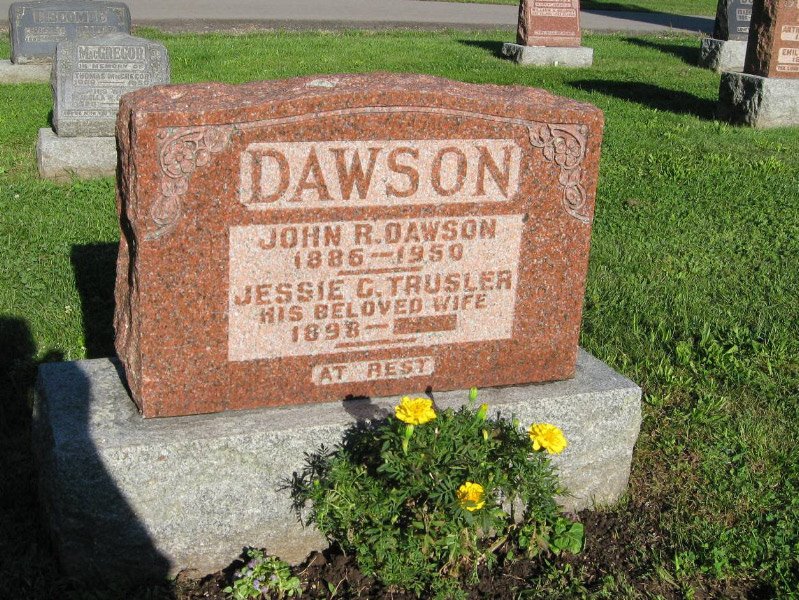
Below is the tombstone for John "Jack" Russell Dawson, 1886-1950, and his wife, Jessie G. Trusler, 1898-(blank). The Council Office for the Cemetery has no information on a death date for Jessie- only that she purchased the lot back in 1950. I need to query the local funeral home. The OGS, Waterloo Branch, book of tombstone inscriptions mentioned that Dawson was the recipient of the Veterans Cross, but I could not find any evidence of this award at the grave site. A plant of annual, yellow Marigolds graced the tombstone, so apparently there is family in attendance.
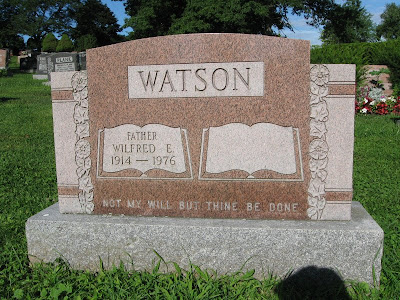
One of the pall bearers at Jack Dawson's funeral was Wilfred Watson. His tombstone is also at Mount View: Wilfred, "father", 1914-1976.
There were several grand-looking churches in the former city of Galt. The churches with their tall steeples straddle the Grand River which runs through the center of the city. The city was merged with the political districts of Preston and Hespeler about 1975 to form the city of Cambridge. Though you will not find the city of "Galt" on a modern map of Ontario, you will see several references to Galt around the city. Below is the Trinity Methodist Anglican Church in Cambridge, formerly Galt. Jack Dawson was an "adherent of the Wesley United Church" according to his obituary. Perhaps a reader will inform me how the church pictured here fits into the Methodist community of Cambrige.
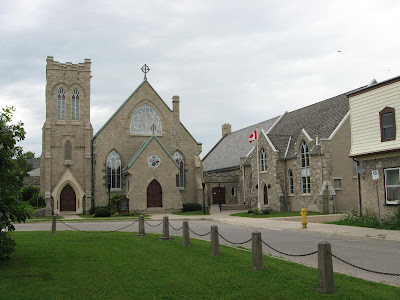

Image: Trinity Anglican Methodist Church, Galt (Cambridge), Ontario Canada

I realize that this entry is agonizingly detailed for the casual reader. However, when someday I casually hand someone a book of my genealogy, I want them to have some idea of just what goes into the research behind the many names and dates of persons memorialized in the text. It's not just numbers.

REFERENCES:

Church Histories of Waterloo County, Ontario, Canada, before 1900 . Though not much help for the Dawson family who came to the area sometime after 1905, at least one of the churches listed at this web site was mentioned in this blog entry (Trinity Anglican).